320,000 Protesters March in France as Youth Unrest Spreads Across Europe
Tear gas and arrests marked the third weekend of demonstrations in Paris, while similar rallies in Germany, Portugal, and the Netherlands focused on housing and education costs.
By Hiroshi Ferrari ·
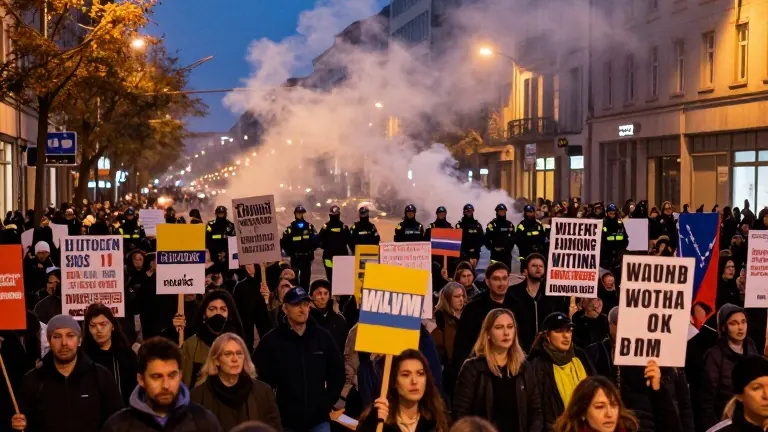
Thousands of people across Europe took to the streets on Saturday to protest rising costs of living, poor educational facilities, and housing shortages. The demonstrations, which began with high school students in France, have expanded to include labor unions, climate activists, and families in multiple countries.
The French government estimated that 320,000 people participated in nationwide protests on Saturday. This number is lower than the 550,000 who marched on Oct. 17 and the 410,000 who protested on Oct. 24. Organizers reported higher turnout figures, though official counts remained the primary metric for comparison.
About 70,000 police and gendarmes were deployed across France following warnings from Interior Minister Laurent Nuñez about a "very high risk" of disorder. Authorities reported more than 560 arrests nationwide by Saturday night. Paris marches were rerouted to the city's edge to protect government buildings and commercial districts in the center.
In the main Paris march, participants carried banners representing diverse grievances, including student housing conditions and university admissions. Corentin Cabreux, a 21-year-old student, described his state-run residence as having "damp stains all along the bottom of my walls, whole sections peeling off, cockroaches everywhere, rats." Other marchers included a gray-haired woman carrying a sign that read "The Old are Fed Up Too," and Cléo Farenc, a 30-year-old gallery assistant, who wore a costume depicting a beheaded Marie-Antoinette.
Farenc explained the symbolism of her costume by stating, "It’s about embodying a figure of power who was brought down by the people. It’s a very strong symbol in French culture." The march proceeded along the Boulevards des Maréchaux with techno music and trick-or-treating activities before clashes broke out near Porte de Charenton.
At the end of the march, protesters threw glass bottles and fireworks at police. Officers responded with stun grenades and tear gas. Smoke filled the air as dusk fell, and many peaceful marchers retreated into the nearby Bois de Vincennes park. Police had previously imposed curfews in central Paris areas and suspended an earlier restriction on minors following a court ruling.
In Germany, a youth initiative called "Gen Z regelt" held rallies in more than 30 cities. Organizers said tens of thousands participated, though official figures were not immediately available. In Berlin, students gathered at the Brandenburg Gate to demand investment in education and housing. Lara Breitenbach, a high school student, stated, "We call for more money to be invested in social services and education, as well as in climate protection.. in short, in our future." Janelle Schulz, another student, noted that her school had a collapsing ceiling and broken toilets.
Violence occurred in several German cities on Saturday night. In Frankfurt, rioters smashed storefronts and stole weapons from a gun store, which police later recovered. In Cologne, police ended a march early after protesters used pyrotechnics and covered their faces. In Hamburg, protesters shot pyrotechnics toward police and burned barricades, prompting the use of water cannons and tear gas.
In Lisbon, Portugal, thousands of people, including families with small children, protested the housing crisis in downtown areas. Placards displayed messages such as "Houses or Fire" and "We are not Afraid." In The Hague, Netherlands, a strong police presence surrounded the downtown shopping area after online appeals for demonstrations. Many stores were boarded up as a precaution, but no major disturbances were reported by midafternoon.