Gaza storm survivors lack shelter as 150,000 tents await entry
Deadly weekend storms have left thousands of Gaza households without shelter as aid agencies warn that restrictions on supplies are worsening exposure to cold and disease.
By Hiroshi Ferrari ·
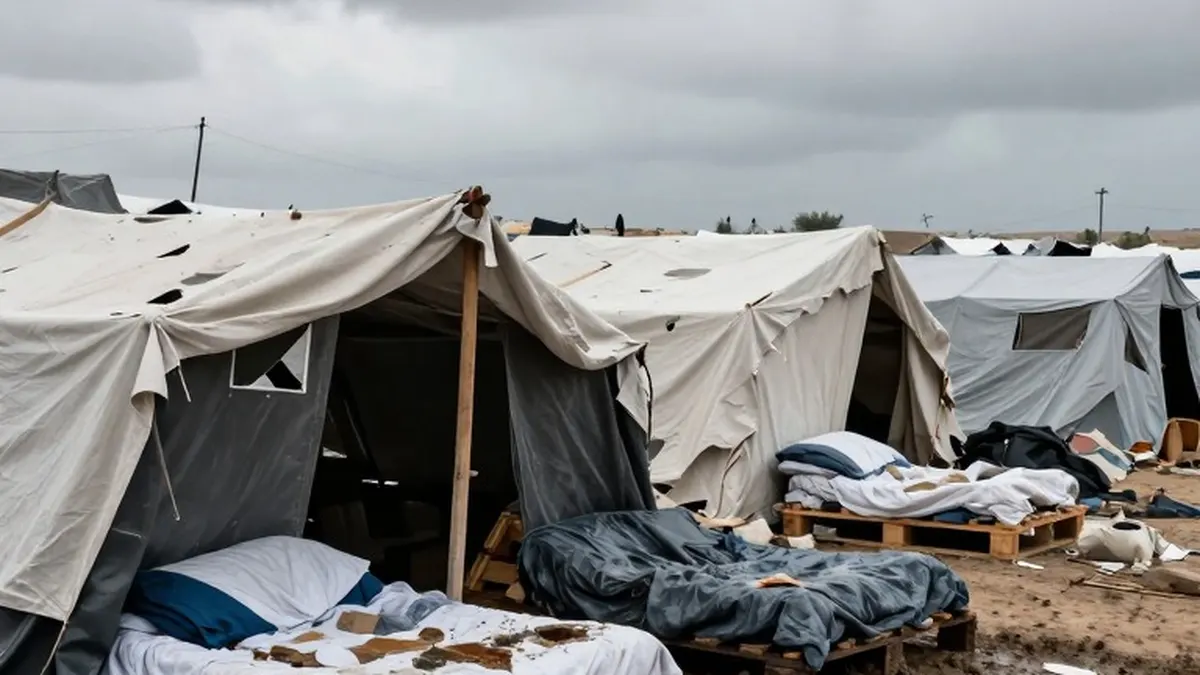
Thousands of Palestinian families in Gaza are struggling to find shelter after weekend storms flooded and damaged their tents, while 150,000 replacement tents remain outside the territory awaiting Israeli permission to enter, according to aid agencies and the UN. Humanitarian workers warn that cold, wet conditions could bring further deaths unless families receive shelter and supplies to keep warm.
At least four children and a woman died during the severe weather, according to the Palestinian health ministry. One child drowned in floodwater, while at least three children and their mother were killed when a sand dune collapsed onto their tent. Damage to sanitation infrastructure sent sewage into tents. The UN said 26,000 households requested assistance after the rain, including at least 3,900 left with no shelter.
Raed Jamal, a displaced Palestinian, said his children were sick, their clothes were soaked and he could not afford replacements. He described spending the night catching rainwater in pots. Videos he shared with the Guardian showed wind shaking his tent and rain entering through holes in its roof. Medical Aid for Palestinians, a UK-based charity, said families had nowhere to move from flooded tents. Its Gaza communications officer, Mai Elawawda, said medical teams expected more respiratory illness and other complications, and feared children could die from hypothermia as they did last winter.
The UN estimates that 940,000 people are living in makeshift tents in flood-prone parts of Gaza without adequate protection from heavy rain. Stormwater pumping facilities are out of operation because they lack electricity, increasing the flooding risk. Palestinians are approaching their second winter since a ceasefire agreed more than a year ago, but aid workers say restrictions on supplies and delays at crossings have prevented improvements in shelter conditions.
Shelterbox said its usual emergency tents had been waiting outside Gaza for almost two years. The charity has instead used tarpaulins and wooden pallets to construct shelters, although those materials also face restrictions. A spokesperson said more durable construction was urgently needed because emergency shelters could not withstand the region's weather. The charity also described an unpredictable approvals process, with toolkits sometimes admitted and sometimes refused without explanation.
Israel said last week that it had permitted 10,000 tents to enter Gaza. The UN, however, said another 150,000 were awaiting entry, with an estimated 94% of Palestinians in the territory needing help to secure shelter. Aid workers said Israeli restrictions on items classified as having dual uses, alongside crossing backlogs, were limiting essential building supplies.
Gisha, an Israeli organisation advocating freer movement of people and goods into and out of Gaza, said entry restrictions were tighter than during previous ceasefires. Israeli authorities report admitting an average of 600 trucks daily, but count 12 pallets as a truckload, compared with the roughly 20 pallets a truck usually carries. That could represent about 40% less cargo. Gisha also accused the authorities of failing to provide transparency about incoming goods.
The Council for Arab-British Understanding urged the British government to press Israel to admit supplies and reverse restrictions on humanitarian workers, including restoring licences for dozens of aid organisations. Meanwhile, Nour al-Batsh, whose child is seven months old, said donations from abroad were helping her pay $500 monthly to share a partially destroyed apartment after her tent collapsed. Still able to see the tent from her current accommodation, she feared having to return as winter approached.