Spain records first general strike in 14 years amid housing crisis
Millions of Spaniards joined a nationwide general strike to protest soaring housing costs ahead of a critical election, marking the first such action in the country in 14 years.
By Larissa Bell ·
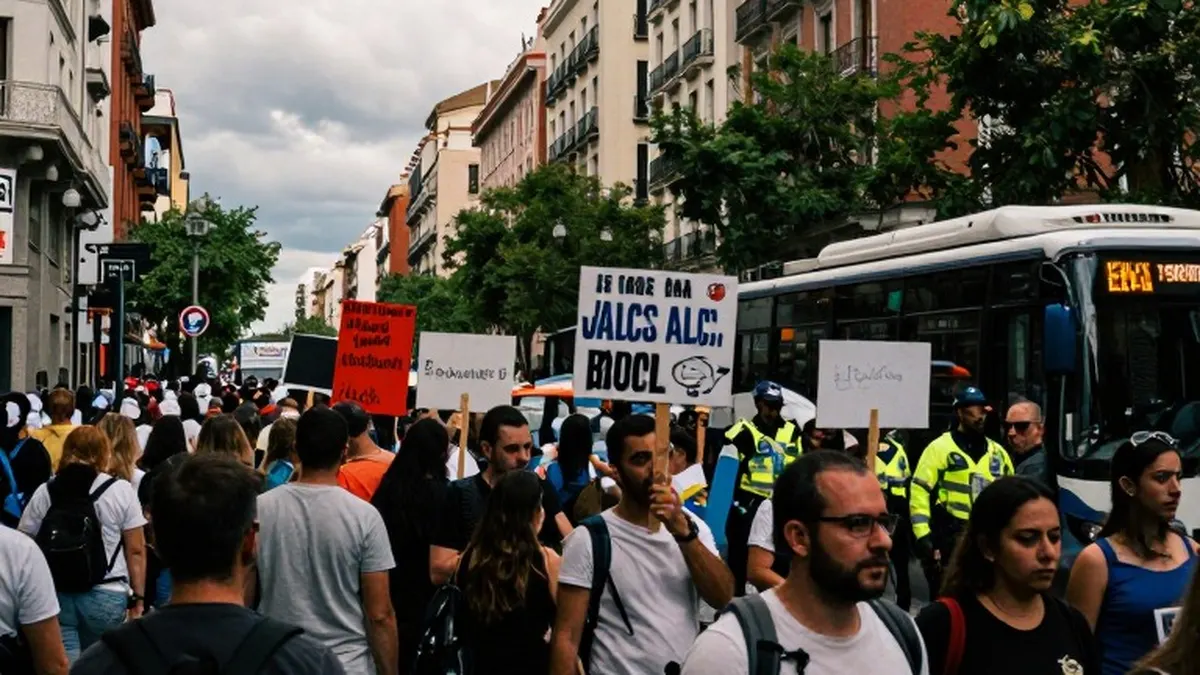
Millions of people across Spain participated in the country's first general strike in 14 years on Wednesday. The nationwide 24-hour stoppage was organized to protest against rapidly rising housing prices ahead of a general election. The action was supported by the nation's largest labor unions and tenants' associations, who sought to highlight the severity of the current housing emergency.
Sandra Mora, a representative from the Madrid Tenants' Union, emphasized the power of the workforce during the demonstration. She noted that workers, who are also renters or mortgage holders, possess the ability to halt production and bring the economy to a standstill. This sentiment underscored the central goal of the strike, which was to push back against the deepening crisis in the Spanish housing market.
Union reports indicated high participation rates in several key sectors. The automotive and port industries saw 90% of workers join the stoppage, while waste collection workers participated at an 82% rate. However, turnout was not uniform across the entire country. Coastal regions such as Catalonia and Andalusia reported the strongest support, areas where the cost of housing has increased particularly sharply in recent years.
The strike significantly impacted daily life and education. Many schools and universities were closed or operated with minimal staff. In Madrid, the labor action compounded an ongoing teachers' strike that had begun nearly a month earlier to demand improved working conditions. Public transport in Barcelona came to a near halt as workers established roadblocks, some of which involved burning tires.
Tensions flared in several cities during the daytime. In Madrid, scuffles occurred between picketers and police near the main wholesale market. Demonstrators also dragged large recycling bins onto the streets to block traffic. By midday, government officials announced that 27 people had been arrested for minor incidents across the country. Additionally, the state meteorological agency issued 14 alerts for two storms expected to bring strong winds, rough seas, and heavy rain, which cast a shadow over planned afternoon marches.
Public frustration with housing costs reached a peak in September following the eviction of Maricarmen Abascal. The 87-year-old resident was removed from her home, where she had lived for more than seven decades. This event sparked widespread protests and encampments, drawing attention to a market where properties are increasingly used for tourist lets and short-term rentals. Data shows that rents have risen by 80% within a decade, while home prices have climbed by 63%.
In a symbolic act of protest, the Granada tenants' union vandalized approximately 300 lockboxes belonging to short-term rentals in the city's most touristed areas. The group posted images of the damaged boxes on social media, declaring their opposition to capitalists and rent-seekers. Campaigners and unions have called on the government to intervene with measures such as rent freezes, limits on evictions of vulnerable people, and stricter regulations on short-term rentals.
Unai Sordo, head of the Workers' Commissions, one of the country's largest unions, stated that the struggle to access housing is the primary issue dividing the nation. The political stakes are high as Spain prepares for a general election on November 29. This snap vote was called by Prime Minister Pedro Sánchez after right-wing parties blocked emergency legislation aimed at addressing the housing crisis.
Current polls suggest that a right-wing coalition between the People's Party and the far-right Vox party is the most likely outcome. Although Sánchez has tried to focus the campaign on social issues, the debate has shifted toward infrastructure following a second deadly high-speed rail disaster this year that killed at least 69 people. Sánchez used the strike to refocus attention on social progress, praising the labor movement for securing rights like the eight-hour workday and national health insurance.
The reaction from the right was sharply critical. Isabel Díaz Ayuso, the leader of the Madrid region, accused striking workers of holding citizens hostage and described the situation as chaotic. Ayuso, who is facing questions over public spending on a penthouse office, told Spanish television that she had urged the leader of the People's Party, Alberto Núñez Feijóo, to ensure the strike would end. Feijóo is currently seen by polls as the likely next prime minister.