Russia Accelerates Production of Small Cruise Missiles Amidst Ukrainian Air Defense Challenges
Russia is ramping up production of fast, small cruise missiles, forcing Ukraine to develop new interception strategies against a more complex aerial threat.
By Hiroshi Ferrari ·
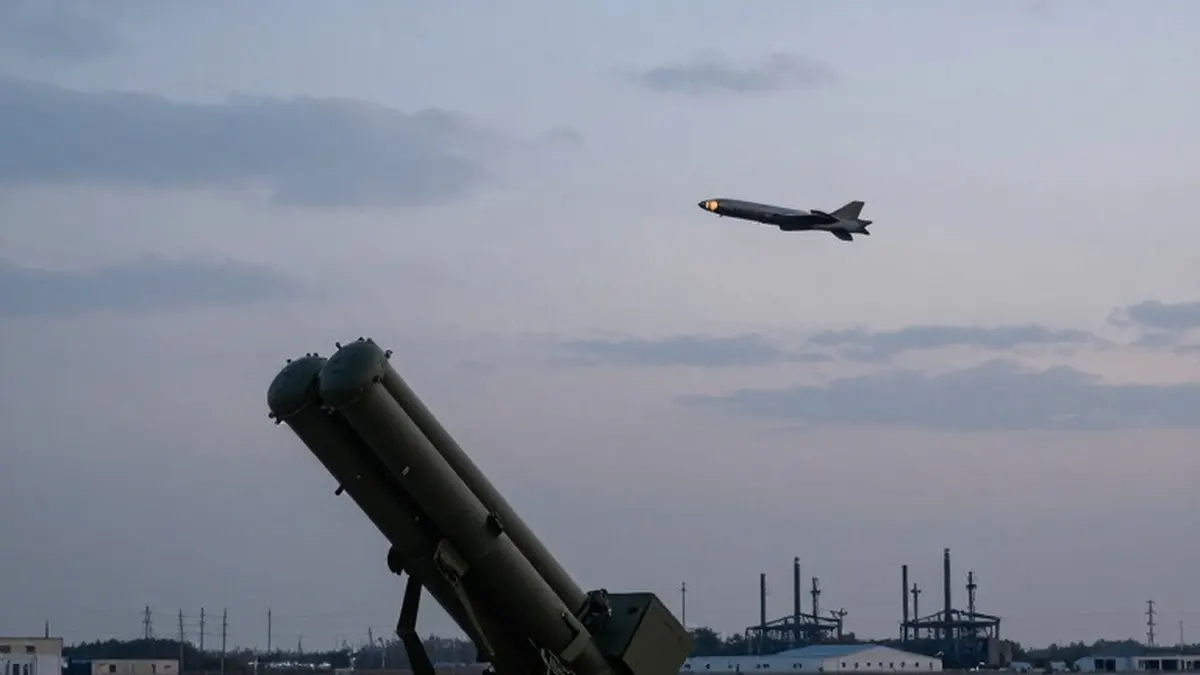
Ukraine faces a rapidly evolving aerial threat as Russia shifts its focus from jet-powered drones to a new class of small cruise missiles. These weapons, which resemble scaled-down versions of conventional systems like the Kh-101 and Kalibr, utilize similar components and warheads as long-range attack drones. The primary distinction is their increased speed, which makes them significantly more difficult to intercept than their drone counterparts.
According to calculations by Ukrainska Pravda based on public data, Russia intends to manufacture tens of thousands of these small cruise missiles in the coming year. Capable of flying at speeds exceeding 600 km/h, these missiles represent a serious escalation in the conflict. While Ukrainian air defenses have improved their success rate against jet-powered drones to 66% last month, the military emphasizes the urgent need to prepare for this faster and more maneuverable threat.
The concept of small, cost-effective cruise missiles was initially pioneered by Ukraine with the development of the Palianytsia, Peklo, and Bars systems in 2024. Unlike traditional cruise missiles that rely on expensive, complex turbojet engines and proprietary military electronics, these smaller weapons use mass-produced components. They feature small jet engines designed for model aircraft, which cost up to US$40,000 each, and utilize civilian electronics available on the open market.
This shift creates a highly competitive environment within Russia’s defense-industrial base. Pavel Luzin, a senior fellow at the Center for European Policy Analysis and the Saratoga Foundation, noted that manufacturers are now producing weapons based on available resources rather than technical perfection. This approach allows for the use of smaller, less powerful engines that can be produced in large batches, a stark contrast to the limited production of large turbojets required for conventional missiles.
Key players in this race include Rostec, KTRV, and Alabuga. Rostec is developing the Dan-T missile, which is reported to be 35% cheaper than the similar Banderol missile produced by the Kronshtadt plant. The Dan-T can be launched from various platforms, including ground launchers, helicopters, and fighter jets. Rostec is also working on the S-71K Kovyor and S-71M Monokhrom, designs intended for launch from Su-57 fighters, with the latter featuring autonomous target search capabilities.
Alabuga, another major producer, is transitioning its Geran drone production to jet-powered variants and developing small cruise missiles based on the Geran-5 platform. Recent modifications, such as the Geran-5 K5-K, have allowed for a reshaped fuselage and internally mounted engines, enabling speeds of up to 900 km/h. This variant also incorporates the Susanin optical navigation system to reduce vulnerability to electronic warfare.
Despite domestic competition, Russia remains heavily dependent on foreign components, particularly jet engines from China. These engines, costing between US$35,000 and US$40,000, are often assembled in Russia to address quality issues. A representative of Ukraine’s Defence Intelligence Directorate stated that Russian drones rely entirely on foreign parts, a dependency that presents a strategic vulnerability.
In October, Russia deployed 360 Banderol and Dan-T missiles against Ukraine. Production of Geran-5 drones is estimated at 700 units per month, with plans to scale up Dan-T production to 14,000 units next year. This increase aims to wear down Ukrainian air defenses and reduce reliance on strategic aircraft for long-range strikes.
Ukraine is responding by developing a variety of interception systems, including the RK-19 anti-aircraft missile and the Shershen multi-calibre air defense system. Experts advise that no single solution will be sufficient. Instead, Ukraine must combine interceptor drones, turrets, anti-aircraft guns, and surface-to-air missile systems. Western partners are encouraged to assist in developing affordable interception technologies, while Ukraine continues to strike Russian production facilities and apply sanctions to disrupt the supply of critical foreign components.