Iran reveals underground missile complex as IRGC signals readiness for broader retaliation
Iran has showcased a new underground missile city housing ballistic and cruise missiles, signaling its military resilience and warning of potential retaliation beyond the region.
By Larissa Bell ·
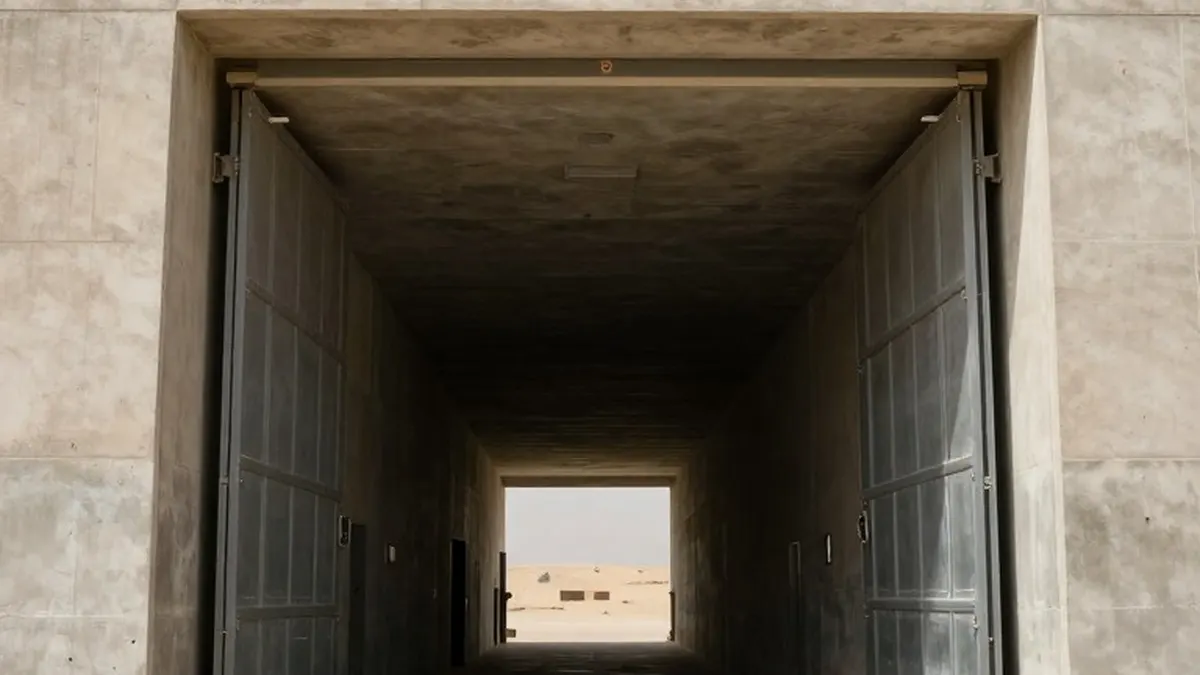
Iran has unveiled a vast underground facility housing its missile arsenal, presenting it as a new strategic asset to demonstrate its enduring military power. The Islamic Revolutionary Guard Corps, known as the IRGC, showcased the site on Tuesday, highlighting its capacity to store and launch both ballistic and cruise missiles. The reveal serves as a significant signal in the ongoing geopolitical tensions between Tehran and Washington, particularly amid recent mediation efforts by Qatar.
The facility was presented through footage released by Tasnim News Agency, an outlet linked to the IRGC. High-ranking military officials toured the site, including Major General Ali Abdollahi, the chief of staff of Iran's armed forces, and Brigadier General Majid Mousavi, who commands the IRGC Aerospace Force. Notably, the previous head of the aerospace force, Amir Ali Hajizadeh, was killed in 2025 during the conflict with Israel.
During the tour, Abdollahi emphasized the strategic value of the installation, stating that advanced missiles would surprise enemies with their battlefield impact. He further warned that if Iran faced renewed attacks, its response would extend beyond the Middle East. This statement suggests a willingness to project power on a wider scale should hostilities resume.
The timing of the unveiling coincides with diplomatic activity, including attempts by Qatar to mediate between the United States and Iran. A recent meeting took place between US President Donald Trump and Qatari Prime Minister Mohammed bin Abdulrahman Al Thani. Additionally, the US has conducted strikes on Iran's Qeshm Island, adding to the complexity of the regional security landscape.
Open-source intelligence analysts have examined the images released by Iran. One analyst noted that the underground city appears to be filled with Fattah-1 medium-range ballistic missiles. Separate maneuvering re-entry vehicles were observed alongside complete missiles equipped with boosters and warheads. Expert Tal Inbar also discussed the visual evidence, identifying what appeared to be a maneuverable re-entry vehicle for the Khiber Shekan missile, possibly developed for the Fateh-1 system.
Inbar also pointed out the presence of older missiles featuring plain conic re-entry vehicles within the facility. A particularly interesting detail captured in the footage was a commercial truck equipped with a hidden missile in its rear compartment. This design allows the missile to be concealed during transit and raised to a launch position, blending in with civilian traffic on roads.
The display underscores Iran's effort to prove that it has preserved its missile capabilities despite sustained airstrikes from the United States and Israel. In March, Israel's prime minister claimed that Iran had lost the ability to enrich uranium and produce ballistic missiles after twenty days of conflict. The new reveal challenges that narrative, suggesting that Tehran's arsenal remains intact and operational.
Iran has spent years constructing these underground storage and launch sites, often referred to as missile cities, to protect its arsenal from detection and destruction. While previous conflicts saw many launchers destroyed, reports indicate that some were merely sealed inside tunnels rather than eliminated. Iran subsequently dug them out, highlighting the difficulty of destroying deep underground infrastructure.
IRGC spokesperson Brigadier General Hossein Mohebbi stated on November 7 that missile and drone production has shifted from aboveground facilities to underground complexes. According to Tasnim, the IRGC is now establishing missile production cities deep beneath the ground. Mohebbi claimed that Iran's domestic expertise and flexible infrastructure would allow weapons manufacturing to continue even under heavy bombardment.
These developments follow repeated strikes by Israel and the US aimed at degrading Iran's missile capabilities. Satellite imagery reviewed by Reuters in February 2026 showed Iran repairing damaged missile bases and reinforcing sensitive nuclear and military facilities. The new underground facility illustrates Iran's intent to convey that it still possesses dangerous missiles, while both the US and Iran appear optimistic about reaching an agreement.