Slovyansk Residents Brace for Evacuation as Russian Forces Target Fortress Belt
In the devastated Ukrainian city of Slovyansk, civilians and soldiers endure constant bombardment while peace talks in Abu Dhabi proceed against the backdrop of a crumbling defensive line.
By Hassan Ellis ·
The risk of entering Slovyansk is immediately apparent to visitors. Tetiana, a member of a drone unit, instructs her companions to run if she gives the order. She and her colleague Yasha escort journalists into the city, which faces relentless attacks from Russian drones, missiles, and glide bombs. The weather is rainy and overcast, a condition military escorts consider favorable because it hinders drone operations. Nevertheless, Yasha maintains a constant watch on the sky, while Tetiana monitors her smartphone for the latest intelligence on potential air threats.
Tetiana and Yasha belong to a drone unit that has adopted the name Peaky Blinders, referencing the popular British television series. Their members wear camouflaged flat caps, a nod to the show's iconic imagery. Slovyansk is one of four cities that comprise Ukraine's fortress belt, a system of heavily fortified defensive lines in the parts of the Donetsk region still under Ukrainian control. Russia seeks to have Kyiv relinquish these cities, a demand that has become central to peace negotiations between Ukraine, Russia, and the United States in Abu Dhabi. These talks resumed after a nine month hiatus. Ukrainian officials fear that ceding these positions would allow Russian forces to advance further west, potentially toward the capital.
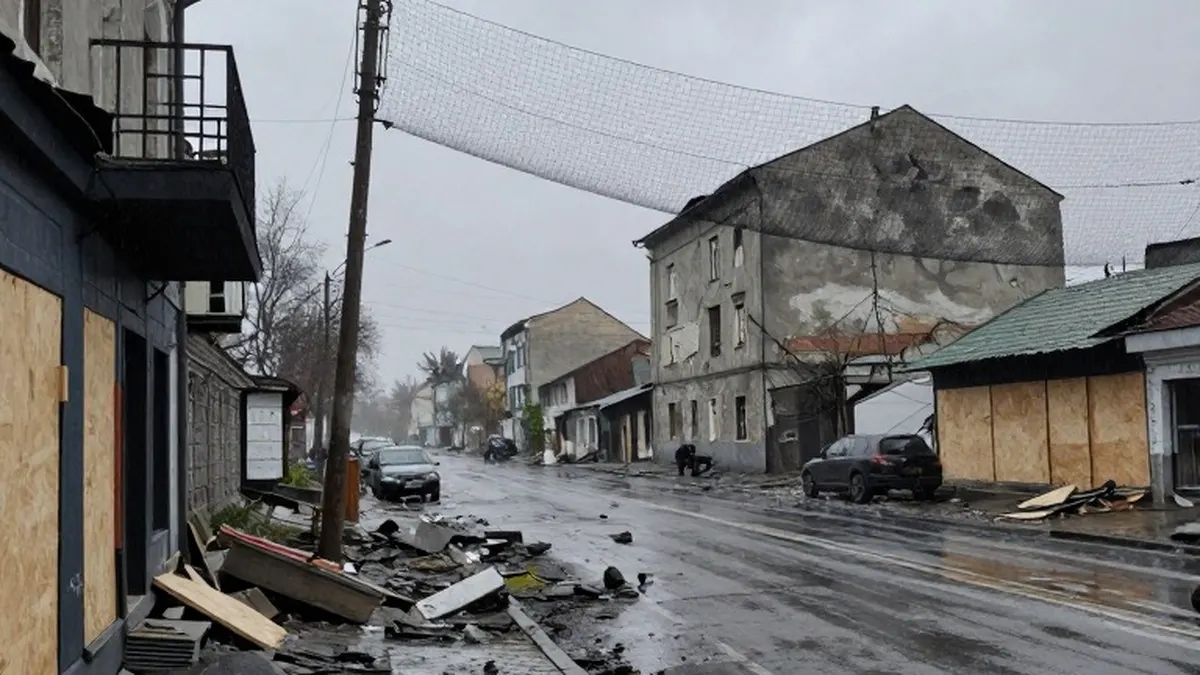
Inside the city, vehicles are concealed under tree cover as visitors move on foot. Yasha carries a shotgun, a final defensive measure against low flying drones. Tetiana notes that walking is safer than driving. The streets are littered with abandoned vehicles, many destroyed by Russian first person view drones. Anti drone netting covers the roads, but it offers no absolute safety. Tetiana shares a recent video on her phone, showing the sound of drones buzzing overhead and the rapid fire of small arms as Ukrainian forces attempt to shoot them down. She admits the experience is frightening, explaining that she abandoned her dream of becoming an opera singer to help her country.
Slovyansk has been reduced to a shell of its former self. Very few buildings remain intact, with many turned to rubble. Tetiana points out a school recently destroyed by glide bombs and a residential block with a large hole in its side. Broken glass covers the pavement. The few shops still operating are boarded up, making it difficult to tell if they are open. Most have closed. Tetiana says the Russian strategy is to intimidate residents into fleeing in chaos, leaving them with nowhere to live. This pattern mirrors the fate of other Donbas towns like Pokrovsk and Bakhmut, which have become ghost towns before falling to Russian control.
Russia has captured nearly 90% of the Donbas, which includes the Luhansk and Donetsk regions. However, its advance has largely stalled this year due to strong Ukrainian resistance. The White House has expressed optimism about the renewed talks in Abu Dhabi, despite President Volodymyr Zelensky's refusal to cede territory. October was the deadliest month for Russian troops since the full scale invasion began, with more than 54,000 killed or injured according to Ukraine's general staff. Despite these losses, Russian forces continue to make life in the fortress belt cities nearly impossible.
Before the war, Slovyansk was home to more than 200,000 people. Fewer than 10% of the original population remains, and the number declines daily. Yet, amid constant air raid sirens, signs of life persist. Iryna, a local resident, works in one of the city's last coffee shops. She says she is forced to walk around crying and asks how such destruction can be allowed. Although she has lost her house, she refuses to leave, stating that Slovyansk is her home. Inga, 53, also born in the city, continues to work despite the danger. She cites fear of the unknown and a lack of financial resources as reasons for staying, noting that she does not consider any other part of Ukraine truly safe.
The drone unit first met the journalists two years ago in the Kharkiv region. Only four original members remain, with others transferred, wounded, or killed. The unit's leader, Oleksandr, lost his brother in the conflict and now views the team as his family. He jokes that their unit is like the TV show but without the crime and drugs. Every evening, they share a meal while Oleksandr reads a prayer of thanks for their survival. Classical music plays over a speaker to help drown out the sound of nearby explosions. Oleksandr describes the current situation as the most difficult they have ever faced. He insists that holding the line is crucial to inflicting maximum damage on the enemy. He rejects Russia's claim that seizing the Donbas will end the war, arguing that the intense fighting proves otherwise.
The fortress belt cities provide Ukraine with a strong defensive line and a significant obstacle to Russian advances. The high density of drones in the area now makes it nearly impossible for either side to move forward. Although peace talks have resumed, Oleksandr notes that they have not yet produced results. He wants the war to end but does not believe the negotiations will succeed. The next morning, a dozen civilians arrive at an evacuation point in the city center. They carry all their belongings and are moved into a bunker for safety. Heavy small arms fire erupts outside, signaling the presence of more drones. Alina Shyrko, a resident coordinating the evacuation, says the situation has deteriorated rapidly. Families with children have been ordered to leave. She admits that many, including herself, are considering departure. Ukraine still holds Slovyansk, but its population is steadily draining away.