India's 1.5 Million Road Deaths Reveal a State Capacity Crisis
Despite a strong digital infrastructure, structural weaknesses in governance and local administration hinder development in the world's most populous nation.
By Hiroshi Ferrari ·
India, the world's most populous country, faces a convergence of development challenges that range from education and health to manufacturing and urbanization. Climate change and the rise of artificial intelligence add further uncertainty to the next two decades. However, analysts argue that the central obstacle to progress is not the scale of these problems, but the competence of the Indian state itself.
The fundamental issue is the quality and integrity of government institutions. India’s political landscape, from the right-wing Bharatiya Janata Party to the left-wing communists, shares a statist ideology that places the state at the center of economic and social direction. Yet, there is little visible effort to improve how the state actually functions, despite mounting pressure from development goals.
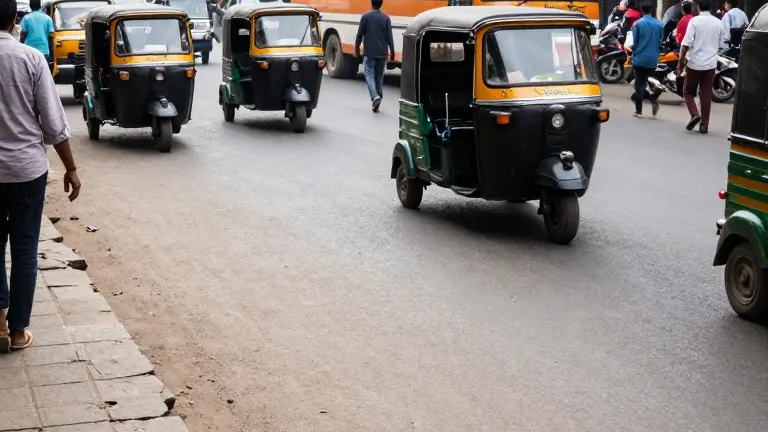
The consequences of this ineffectuality are visible in daily life, particularly in urban areas. Over the past decade, more than 1.5 million people have died in road accidents in India. The fatality rate is far higher than the global average per distance traveled. Roughly one-third of these victims were pedestrians, often killed because cities failed to maintain basic infrastructure like sidewalks. This neglect reflects a deeper weakness in urban governance and state control over land.
The private sector drives economic activity, but it relies on state foundations such as law and order, health, and education. While violence has declined, the police are often viewed as predators rather than protectors. Tens of millions of cases sit in overwhelmed courts, making the legal process a form of punishment in itself. If businesses cannot enforce contracts and citizens cannot walk safely, the base for development remains fragile.
The state also fails to convert India's large population into human capital. High rates of malnutrition and stunting limit the potential of millions of children. Although school enrollment has increased, learning outcomes in public schools are poor. Hiring teachers has become a source of political patronage, and the middle class avoids public schools, removing a key constituency for reform. In higher education, ideological control often takes precedence over practical skill development.
India's administrative structure compounds these issues. Unlike China or the United States, which distribute public employment across federal and local levels, India concentrates it in state governments. This centralization deprives cities of authority. A rigid hierarchy and a system of frequent bureaucratic transfers, known as the transfer raj, create a culture of mistrust and status consciousness. The result is a state described as having the engine of a bullock cart and the brakes of a Rolls-Royce.
Recent years have seen increased centralization as politics become more autocratic. The federal government exerts greater control over provinces, which in turn dominate local governments. This structure allows politicians to extract rents and use the state to pressure opponents. Public employees form a powerful group that resists reform, ensuring that administrative changes rarely align with electoral cycles.
India has built a world-class digital public infrastructure that has improved taxation and welfare payments. However, this technology also makes it easy to transfer money to voters, encouraging competitive populism. The state prefers to distribute direct benefits over building core public goods, which maintains citizen dependence. Experts note that while the state could improve by cooperating with civil society and private firms, it often seeks to control these groups for political reasons.
Official reports have documented these state failures for six decades, yet the pathologies persist. The core institutions of the state, including courts, regulators, and the Election Commission, are weakening. This strategic weakness is not an accident of electoral competition but a deliberate choice by India's political class. Unless this choice changes, meeting development goals by 2050 will be difficult.