SS United States to Become World's Largest Artificial Reef
The historic ocean liner will be sunk in the Gulf of Mexico this week, ending decades of debate over its preservation.
By Hiroshi Ferrari ·
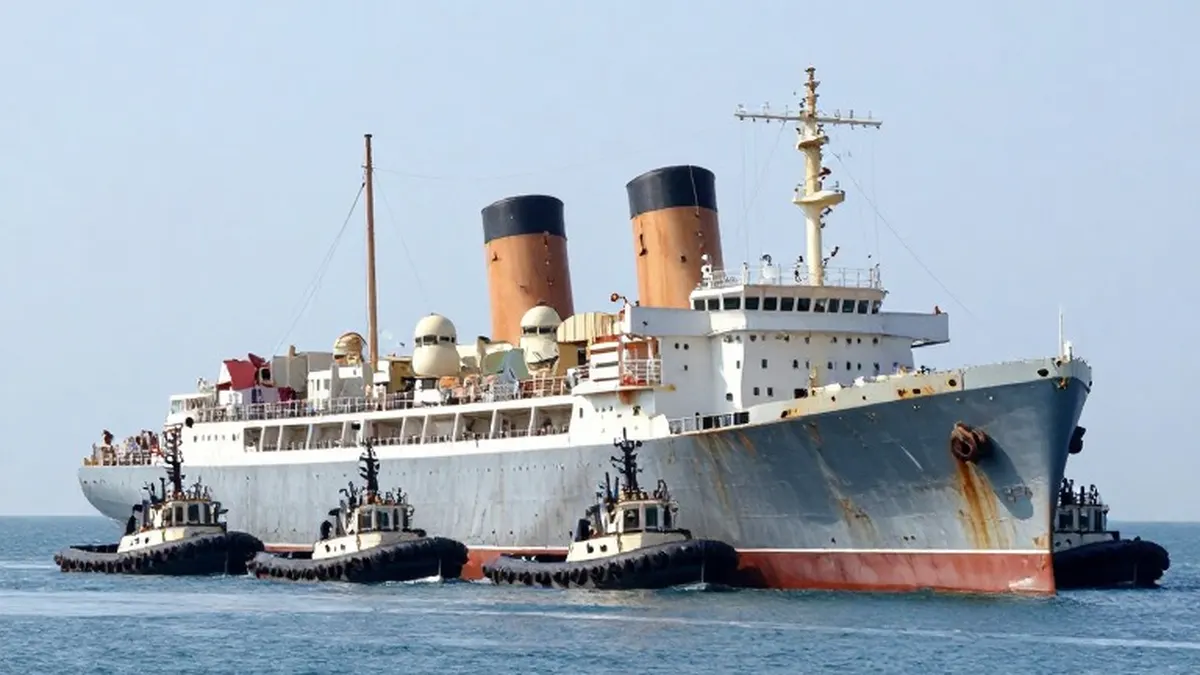
Final preparations were completed on Tuesday for the submersion of the SS United States, marking the conclusion of a long dispute regarding the fate of the famous transatlantic vessel. The ship is set to be deliberately scuttled in the Gulf of Mexico, where it will serve as the world's largest artificial reef.
A fleet of five tugboats transported the rusting liner from a dock in Mobile, Alabama, on Monday. The vessel is on a short journey to a location approximately 25 miles off the coast of Destin, Florida. A precision operation is scheduled for Wednesday afternoon to ensure the ship sinks safely.
This quiet departure contrasts sharply with the ship's earlier years, when it was a symbol of luxury and speed. More than half a century ago, the liner carried presidents, royalty, and celebrities between Europe and North America. It still holds the record for the fastest transatlantic crossing by a passenger ship, a feat achieved in 1952 with an average speed of nearly 36 knots.
The decision to turn the ship into a diving site was not the original wish of preservationists. The United States Lines, now defunct, stopped operating the vessel in 1969 as air travel became more popular. Various plans to convert the ship into a hotel, museum, or venue failed to secure sufficient funding.
The liner spent many years sitting in Virginia and Pennsylvania while legal battles over its future unfolded. It changed hands several times, including a period under the care of the SS United States Preservation Society, a non-profit group established in 1992 to prevent it from being scrapped.
In 2021, Philadelphia port authorities doubled the daily dockage fees to $1,700, a cost the conservancy could not sustain. By 2024, a court order forced the deteriorating ship to leave the dock. It was nearly destined for the scrapyard until Okaloosa County in Florida purchased it for $1 million later that same year.
Following its purchase, the ship was moved to Mobile for extensive preparation. Workers removed internal fixtures and toxic materials over several months. The vessel will be sunk using controlled flooding, a method that avoids the use of explosives. Once on the seabed at a depth of about 180 feet, the 990-foot ship will be accessible to divers starting this weekend.
Susan Gibbs, president of the conservancy, expressed appreciation for the new arrangement. Although the ship will be out of public view, she noted that visitors can still explore it underwater and learn about its history. Plans are already underway for a shore-based museum that will display the ship's funnels and other artifacts.
Gibbs, who is the granddaughter of the ship's designer, William Francis Gibbs, said the museum is a vital part of the project. The conservancy has spent two decades collecting artifacts, films, and testimonials from former crew members and passengers. She described the combination of the underwater reef and the land-based museum as a moving way to honor the ship's legacy.
Gibbs shared that her grandfather considered the SS United States one of his greatest achievements. He was deeply attached to the vessel, often joking that he loved it more than his wife. He would see the ship off on every voyage and greet it upon its return, a relationship she described as a true love affair.