Egyptian train crash sparks political debate over railway safety and accountability
A fatal train collision in Cairo has triggered a wave of parliamentary demands for accountability, prompting scrutiny of railway investments and government performance.
By Hiroshi Ferrari ·
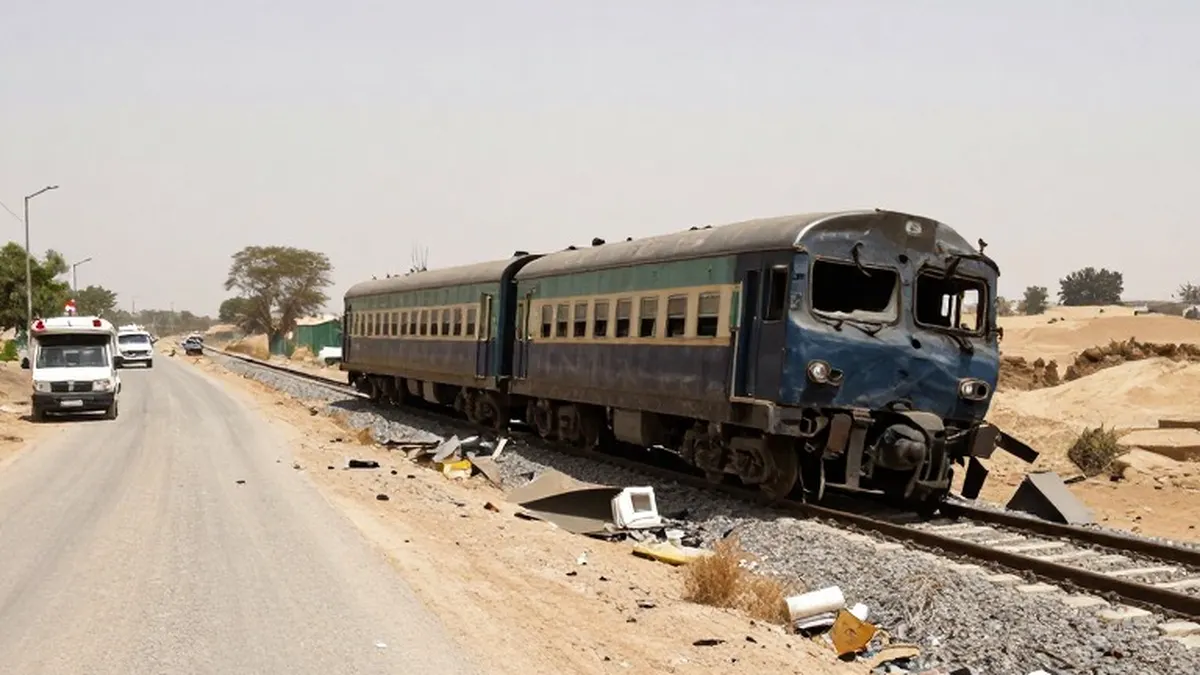
A severe train collision in the outskirts of Cairo has intensified political tensions in Egypt, with lawmakers and opposition figures demanding urgent accountability. The accident, which occurred on Sunday in the al-Ayyat district, resulted in the deaths of at least seven people and left more than 125 others injured, according to the Ministry of Health and Population.
The disaster has prompted President Abdel Fattah el-Sisi to order an immediate investigation into the incident. The president instructed authorities to identify and hold responsible any individuals found to be negligent in the handling of the railway network.
The crash involved a train traveling between Giza and Fayoum, which rear-ended another train on the Cairo to Aswan route. The impact caused the second train to derail onto a nearby countryside road. This event has raised significant questions about the effectiveness of millions of dollars invested by the state in upgrading railway infrastructure and passenger safety.
Abdel Moneim Imam, a member of Parliament and leader of the Justice Party, argued that the recurring accidents in the al-Ayyat corridor indicate a lack of genuine accountability among officials. He cited previous tragedies in the same area, including a 2002 fire that killed over 370 people, a 2009 collision that killed 15, and three separate crashes in 2016 that resulted in 14 deaths.
Imam stated that decisive measures and the holding of officials accountable for past incidents could have prevented the latest disaster. He noted that the transport minister is protected by the parliamentary majority, which he believes hinders the activation of proper parliamentary oversight.
On Tuesday, the Egyptian parliament’s Transport and Communications Committee held an emergency session with Transport Minister Kamel el-Wazir. Ahmed el-Derby, the committee secretary, explained that the meeting was intended to discuss the circumstances and preventive measures rather than to confront the minister with premeditated accusations.
El-Derby emphasized that officials bear responsibility for mistakes occurring during their tenure, even if they did not personally make the errors. He advised against hasty calls for dismissals, arguing that removing personnel alone does not solve the underlying crisis.
Atef el-Maghawry, head of the Tagammu Party’s parliamentary bloc, suggested that the repeated accidents point to broader government policy failures beyond the Transport Ministry. He called for the dismissal of the entire government, stating that a change in policy is required rather than a simple change in personnel.
Parliamentarians are also demanding greater financial transparency regarding railway funding. Irene Saeed, head of the Reform and Development Party’s bloc, requested a detailed breakdown of how loans obtained in 2026 were spent. She specifically asked for data on the proportion of funds allocated to safety, signaling, and maintenance during the current minister's tenure.
Hassan Mahdy, a highway engineering professor at Ain Shams University, urged caution before drawing final conclusions. He highlighted that investigators must determine why one train stopped on the main track and whether the second train's signaling system provided adequate warning. The Transport Ministry has stated that approximately $37 billion was allocated to transport investments between 2014 and 2024.