Bavaria Weighs Rebuilding Nazi Retreat After Fire Destroys Kehlsteinhaus
Officials, historians, and residents argue over whether to reconstruct the alpine structure, demolish the ruins, or preserve the damage as a memorial.
By Larissa Bell ·
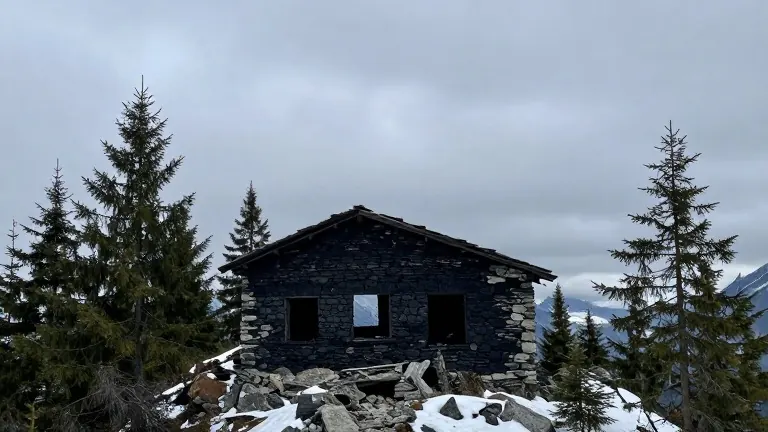
Bavarian authorities are debating the future of the Kehlsteinhaus, the alpine retreat destroyed by fire on October 23. Interior Minister Joachim Herrmann and Arts Minister Markus Blume have voiced support for rebuilding the structure, arguing that leaving a ruin on the ridge is untenable. Blume specified on local radio that any reconstruction project must not require taxpayer funding, while Herrmann stated that a sensible solution will be developed in consultation with historians.
The building, constructed in 1938 and known locally as the Eagle's Nest, served as a private domain for Adolf Hitler and other senior Nazi figures. Situated at 1,834 meters above sea level, the site operated as a restaurant for decades following World War II. It drew tens of thousands of visitors annually who ascended via a historic brass and mirror-paneled lift. The structure was designated a historical monument, though it has long been viewed by some critics as a vanity project that was later romanticized by its popular English name.
Police suspect the blaze was an arson attack and have detained a 33-year-old man with a history of mental illness in a secure psychiatric facility. Authorities have not yet disclosed a specific motive. The nearby Obersalzberg Documentation Centre, a museum dedicated to the Nazi era, survived the fire. A photo exhibition regarding the building's history, which had been on display for approximately 15 years, was housed inside the Kehlsteinhaus.
Historians are divided on the best path forward. Professor Richard J. Evans of the University of Cambridge suggested that the site should be cleared to return the mountain to its natural state. He compared the situation to the Berlin bunker, which was filled with concrete and topped with a playground. Conversely, Professor Isabel Heinemann of the Ludwig-Maximilians-Universität in Munich argued against a full reconstruction, stating that it would restore highly ideological architecture. She proposed documenting the fire damage and rebuilding parts in a modern style to keep different historical layers visible.
Sven Keller, head of the Obersalzberg Documentation Centre, cautioned that abandoning the ruins could encourage neo-Nazi pilgrims to hike the site undisturbed. He noted that Hitler's Berghof residence was demolished in 1952 after being bombed, yet the site remains a focal point for memory. Keller expressed doubt that a one-to-one reconstruction is feasible.
The dispute occurs as the far-right Alternative for Germany party gains strength and the Freedom Party rises in Austria. These developments have intensified national discussions on Erinnerungskultur, the culture of remembrance. In Saxony, local councillors recently moved to ban brass commemorative plaques, while Austria opened a police station in the house where Hitler was born in Braunau am Inn.
The debate over the Kehlsteinhaus reflects a wider tension in Central Europe regarding how to manage physical evidence of the Nazi past. Residents and officials are grappling with the balance between active remembrance and the potential for the site to become a symbol of ideological nostalgia.