Gaza residents assess damage after deadly storms subside
As heavy rains recede in the Gaza Strip, thousands of displaced families are confronting widespread destruction and new losses following a sandbank collapse that killed four people.
By Larissa Bell ·
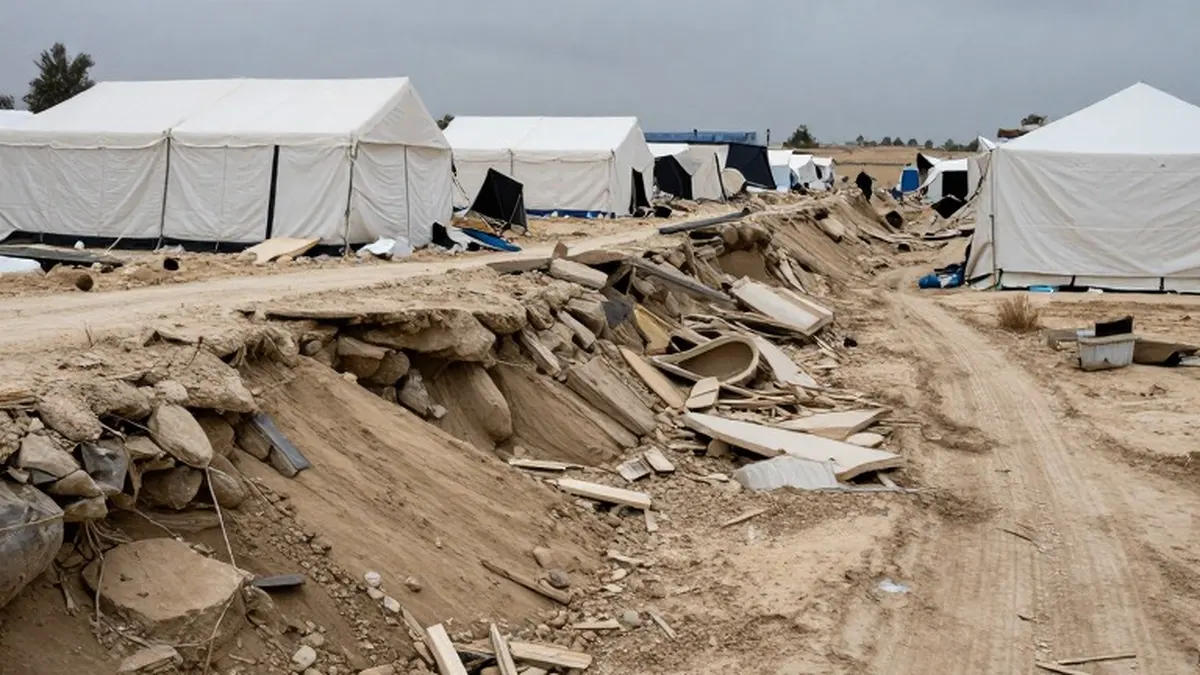
The Gaza Strip is currently engaged in the arduous task of cleaning up after catastrophic flooding that has submerged displacement camps and cities already weakened by war. According to UNICEF, the heavy rainfall has directly impacted 106,000 individuals, leaving thousands of tents underwater and causing latrines to overflow into residential areas. The storms, which began on November 6, have marked a significant escalation in the challenges faced by residents during the winter season.
The most severe incident occurred on Sunday evening at the Ard al-Ribat displacement camp in central Gaza. A sandbank, weakened by the pressure of the rain, collapsed and killed three children and a woman. With a lack of excavation equipment available, residents were forced to dig through the sand with their bare hands to reach those trapped under the debris. As darkness fell, neighbors used their mobile phone flashlights to search for survivors in the chaotic scene.
Zahira al-Sahar, a 58-year-old resident, was inside her tent with her 28-year-old daughter when the collapse happened. She described the moment the sand reached her neck and nearly buried her daughter. Her sons rushed to the rescue, pulling her daughter out first before returning to save her. Al-Sahar recounted how she and her neighbors shouted for help regarding the al-Nabhan family, who were buried in an adjacent tent.
Tragically, the al-Nabhan family did not respond to the calls for help. Eight-year-old Salah, his six-year-old sister Maryam, and their mother Tahrir, who was five months pregnant, were among those killed. Their father, Ahmed al-Nabhan, who had recently been released from Israeli detention, was the sole survivor of the family. Neighbors noted that the couple had been looking forward to their new child following his release from prison.
The collapse also claimed the life of Habiba, a four-year-old girl from the neighboring al-Zein family. Her mother, Reem, and brother Ibrahim remain in intensive care. Suhaib Abu Darabi, a neighbor who helped with the rescue, described the sound of the collapse as resembling an explosion. He noted that the site was on unstable ground and exposed to the elements, leading to a rapid failure of the structure that overwhelmed the limited resources of the residents.
According to the United Nations Office for the Coordination of Humanitarian Affairs, more than 26,000 households reported damage to their shelters or belongings by November 8. The UN estimates that approximately 1.4 million people, or 65 percent of Gaza’s population, were living in tents or makeshift shelters when the storms began. This is the fourth winter since the war commenced in October 2023, leaving hundreds of thousands in temporary structures that have been exposed to the elements for years.
The extensive destruction of infrastructure has compounded the danger. Drainage networks are severely damaged, and municipalities lack the equipment needed to remove accumulated rainwater or respond effectively to emergencies. Gaza’s Government Media Office described the sandbank collapse as a humanitarian disaster, holding Israel, the United States administration, and the international community responsible. The office cited the blocking of construction materials, fuel, and mobile homes as key factors in the deadly floods.
In response, the Board of Peace stated that it had urged Israel to allow essential supplies, including temporary shelters and drainage equipment, to enter the enclave. Aid organizations have also repeatedly called for the entry of shelter materials to prevent similar deadly events in the future. They argue that proper equipment is necessary to repair damaged tents and maintain critical infrastructure.
Shaima al-Daour, a 22-year-old nurse working in the camp, witnessed the aftermath firsthand. She attempted to resuscitate a young child with internal bleeding and assisted a 15-year-old boy with breathing difficulties. Without an ambulance available, she called on nearby men to find any means of transport to get the boy to a hospital. Al-Daour expressed her shock and fear for the coming winter, pleading for compassion from the world as residents continue to cope with the loss and damage.